
How to Export CAD Text & BOM Inventory to Excel
Search device tags, filter by layer, and download one spreadsheet for annotation audits and BOM-style inventory deliverables.
Free online tool
CAD Text Extractor & BOM Export
Use the tool first, then follow the steps below for detail.
Recommended blogs
In this guide
Introduction
Pull every annotation off the sheet — device tags, pipe sizes, room names — with layer name and X/Y position, then export a full label and layer inventory spreadsheet for audits and procurement checklists.
Someone on the review team always asks for a device list. Copy-pasting tags off a PDF print is miserable and you will miss rows. Pulling TEXT and MTEXT straight out of the DWG is faster and you keep the coordinates if anyone asks where a tag landed.
Below is how the CAD text extractor BOM export fits into that kind of QA work.
Tags, labels, and the spreadsheet nobody wants to build by hand
AHJ checklists often want every SD tag, head mark, or valve label listed. The drawing already has that data as TEXT/MTEXT. Exporting it with layer name and X/Y beats retyping from a plot.
Filter by keyword when the sheet mixes architectural room names with device tags search SD-, HS-, SPK-, whatever your project uses.
For procurement, combine a text export with layer counts from the analysis panel. One Excel file attached to the submittal email and QA is documented.
From drawing labels to spreadsheet
Compliance reviews need every SD-xxx tag listed. Export the full text inventory to Excel instead of copying manually from PDF prints.
Submittal inventory in one export
Combine layer entity counts with text labels for a deliverable BOM-style spreadsheet — useful for internal QA before sending drawings to the owner or GC.
Where this shows up on a real job
Foreman on site gets Rev 3 on a phone and needs to confirm head count on Level 2 before Monday's walkthrough open the DWG, run CAD text extractor BOM export, no trip back to the trailer PC with the only AutoCAD license.
Owner rep during tenant improvement doesn't own CAD but needs to see alarm device layout share link or walk them through the viewer in a meeting.
BIM coordinator gets consultant DWG Friday at 4pm; Revit import is Monday. Validate or convert over the weekend in the browser instead of waiting for IT to install TrueView.
Commissioning agent building a tag list for sign-off extract text once, filter in Excel, attach to the report.
Plan reviewer comparing two revisions side by side same tool, two browser tabs, or export between steps if your process requires saved files.
Field notes
Export text before you rename layers if tags reference old layer names in your spreadsheet notes.
Excel sort by layer column groups devices by system FA vs SP vs plumbing that leaked into the file.
Large exports can be thousands of rows. Filter early; room names on A-ANNO-FLR aren't device tags.
Step by step
The tool page has a live workspace at the top same engine as the full viewer. Upload there or use Upload DWG in the header if you want the whole screen.
Free launch limit is 15 MB per file. That's most single-floor fire plans. Campus packs may need to be split by sheet annoying, but still faster than shipping drives.
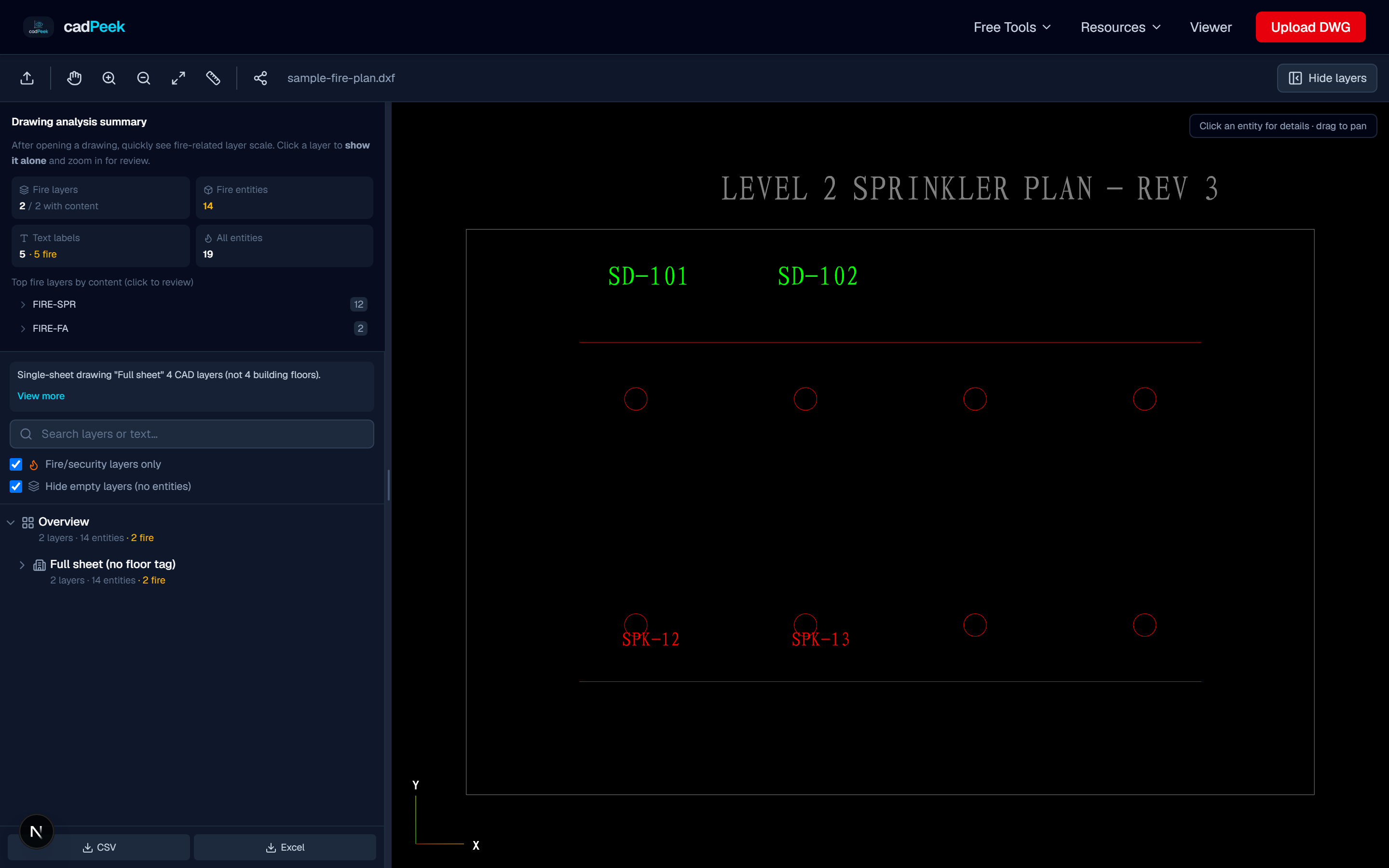
- Upload DWG/DXF: Text index and layer stats build automatically.
- Search & filter: Find keywords or filter by layer.
- Export Excel: Download label and inventory .xlsx.
File prep checklist
Confirm the attachment opens corrupt zips and truncated downloads happen on mobile hotspots.
Note the AutoCAD version if the inspector asks; file inspector shows it without opening desktop software.
If xref paths are broken, you may see empty sheets until the sender binds xrefs. Browser viewers can't fix missing xref files on your machine.
For CAD text extractor BOM export, work on a copy if your contract requires preserving the received file byte-for-byte in the project folder.
After you're done, archive what you exported (DXF, Excel, report text) next to the share link URL in your project log. Future you will forget which link was which.
If the GC asks "can you send that again?" you already know which revision you processed your filename discipline pays off here.
When in doubt, call the engineer before you re-export. Five minutes on the phone beats a wrong file in the record set.
Things that still bite you
Tianzheng and some plugin DWGs open partial in any web viewer, not just ours. If the sheet looks empty or blocks won't explode, ask for standard DWG/DXF from AutoCAD we've seen that more on imports from overseas consultants than domestic shops.
Always check units before measuring. We've seen metric files opened with feet assumed and spacing "violations" that were just a units mistake.
Keep the sender's original filename when you export. "ProjectX_from_MEP_rev2.dxf" beats "download(1).dxf" when the engineer calls back asking which file you used.
Custom objects may flatten to lines and arcs on export. Most fire plans are 2D lines, blocks, and text that's fine. Weird MEP solids might not convert cleanly.
Sharing is upload-by-choice. If the drawing is sensitive, review locally and only share redacted sheets or specific floors.
Room names and grid bubbles export too if you don't filter. That's normal; filter in Excel before you send the list to the AHJ.
Do you still need AutoCAD?
Yes, if you're editing geometry moving heads, rerouting pipe, updating the model. No, if you're reviewing, converting, counting, measuring, or sending a link to someone who will never edit.
Autodesk's web viewer needs an account and uploads to their cloud. DWG TrueView is free but Windows-only and a chunky install. CadPeek is aimed at fire plan review: layer filters, block counts, text export, measure without a monthly seat for every person who touches the drawing.
Lots of shops keep a few AutoCAD licenses for production and use browser tools for everyone else in the chain.
Quick answers
Is CAD text extractor BOM export free right now?
Yes no account needed during launch. There's a per-file size cap; see the tool page for the current limit.
Bottom line
Pull every annotation off the sheet — device tags, pipe sizes, room names — with layer name and X/Y position, then export a full label and layer inventory spreadsheet for audits and procurement checklists.
Open the CAD Text Extractor & BOM Export tool page, drop in your DWG or DXF, and run it. If the file won't open cleanly, try the file inspector or DXF validator first saves time versus debugging a bad attachment downstream.
Bookmark the page if you get repeat work from the same GC or engineer. The related tools in the sidebar cover layer audit, text export, and share links when this job turns into the next one.
Standard US sprinkler and alarm sheets from mainstream consultants usually open fine. Weird plugin files are the exception and those are painful in desktop CAD too.
Open the free tool
Guide FAQ
Can I try the tools mentioned in this article?
- Yes. Each article links to free tool pages and the viewer open a DWG/DXF and follow along without AutoCAD.
Is this article updated for 2026?
- We refresh articles when workflows or supported AutoCAD versions change. Check the date at the top of the post.
Do I need a paid plan to follow along?
- Most workflows in our articles work on the free tier. Excel export and larger files require Starter or above.
Where can I ask follow-up questions?
- Use account feedback or email support. Popular questions become new Resource Center guides.
Are Chinese-labeled drawings covered?
- Yes. The viewer detects non-English layer names and renders common CAD fonts used on imported drawings.
Can I share this article with my team?
- Link freely to cadpeek.com/blog full republication requires permission.